
Last week Salesforce expanded Headless 360 again. The core platform got its own MCP server, Data 360 got one too, and Slackbot can now reach Salesforce and 20+ other apps from a chat window. Dreamforce is three weeks out, and the direction is not subtle.
A healthcare customer summed it up better than any keynote could. Their agents can now reach a unified patient context from any surface, “without waiting for a purpose-built interface.”
That’s the whole shift in one clause. And it’s the question clients keep asking us in different words: how long until most of our software works this way?
Here’s our read. Not a prediction dressed up as certainty — a working model we’re planning our own business around.
What “headless” means if you run a business, not a codebase
Every app you use is two things: the screens, and the logic and data underneath. For twenty-five years the screens were the only way in. Headless means the underneath becomes reachable directly — by an agent, by another system, by a person typing a sentence in Slack.
The screens don’t vanish. They stop being mandatory.
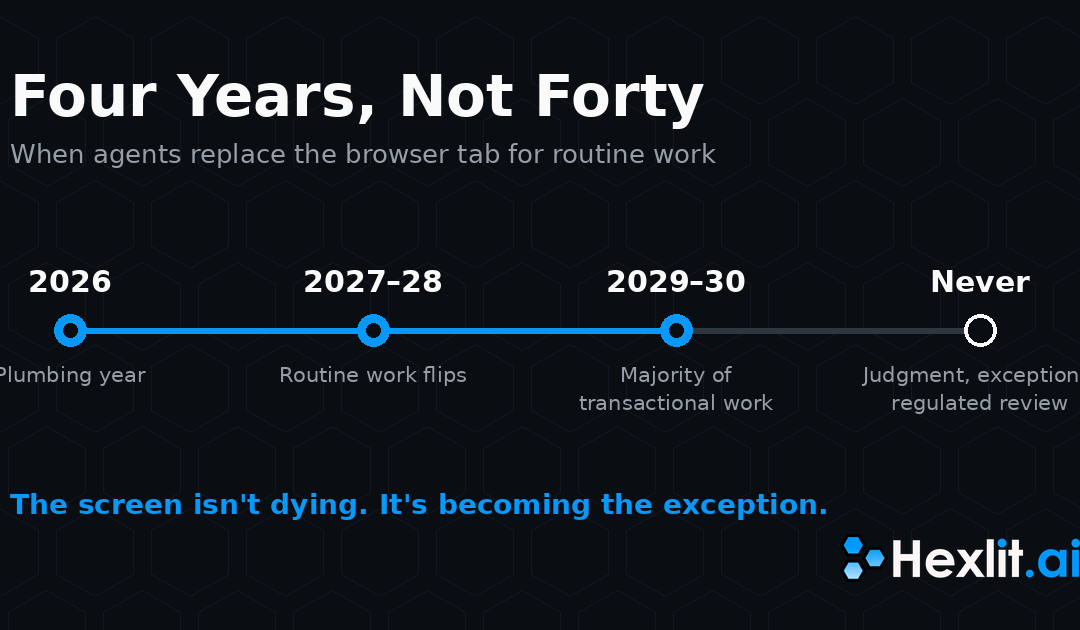
The timeline as we see it
2026: the plumbing year. This is where we are. Vendors are exposing the underneath — APIs, MCP servers, reusable skills. Most agents still live inside a screen. Fine. That’s how it starts.
2027–2028: the default flips for routine work. Status lookups, data entry, handoffs between systems, “did the referral go through.” The tab stays open. You just stop opening it for those.
2029–2030: headless becomes the majority for transactional work. Repeatable, well-defined tasks where the rules are known and the data is clean. This is the window where “most” becomes true.
Never, or close to it: judgment, exceptions, and regulated review. Someone will still look at a screen for a denied claim, a protocol deviation, a patient record that doesn’t add up. In healthcare and life sciences that isn’t a lag. It’s the design. Screens become exception surfaces — fewer of them, built for the moments that need a human.
So the short answer: most software runs headless for routine work around 2029–2030, and it never gets to 100%. Anyone quoting you a single date is selling something.
Why Salesforce customers are in a good position for this
Two reasons, neither of them hype.
The investment carries forward. Every field you cleaned, every Flow you built, every permission set you tightened is something an agent can now act on through the same security model a user gets. Headless doesn’t replace that work. It makes that work pay a second time.
And Salesforce chose openness. The new MCP servers work with Agentforce, but also with Claude, ChatGPT, Cursor, and Teams. You’re not betting on one interface winning. Your system of record becomes reachable from whichever one your team actually uses.
What we’re doing about it at Hexlit
We’d rather show our thinking than tell you to be ready.
We build headless-first. Every automation we ship, we assume an agent will call it, not just a person clicking a button. Explicit inputs and outputs. Logic with names a human can read. No rules that only exist in a screen layout.
We treat the data model as the product. When the screen goes away, the data model is the experience. A picklist nobody trusts becomes an answer nobody trusts. Most of our readiness work is here, and it’s unglamorous on purpose.
We design screens as exception surfaces. Fewer pages. Each one built around a decision a human needs to make, with the context to make it.
We use the same tools on our own delivery. Our builds run through version-controlled, reviewed pipelines with AI-assisted configuration and testing instead of clicking through Setup by hand. It’s faster, it has fewer errors, and it’s a big part of why 50+ projects in the past year landed at a 5/5 average CSAT.
We don’t point agents at an org that isn’t telling the truth yet. Sharing rules, field-level security, audit trail, data quality. That’s the conversation before the agent conversation, every time.
What to do this quarter
You don’t need a strategy deck. Pick one swivel-chair workflow — something a coordinator does across two systems, twenty times a day. Make it callable. Put it in Slack. Measure the time it gives back.
That’s a four-week project, not a four-year one. And it’s the same move whether the “most apps go headless” date turns out to be 2029 or 2032.
If you want a clear-eyed look at which of your workflows are ready to go headless now, which need foundation work first, and what that work costs, let’s talk.
Michael · Hexlit — Salesforce consulting for healthcare & life sciences